If you like these, watch this one
The five games Nara Studio names as influences, what each one shares with this project, and which of them is the closest match for the combat layer.
Nara Studio names Pokémon and Shin Megami Tensei as monster-collector references and Slay the Spire, Balatro and Inscryption as roguelite references. The combat layer reads closest to Slay the Spire's queued-intent planning.
Last checked: 28 October 2026 — the studio's stated influences and each comparison title's own store page.
The studio names its references in the Kickstarter pitch, which makes this the rare comparison page that is not guesswork: Pokémon, Shin Megami Tensei, Slay the Spire, Balatro, Inscryption. Here is what each one actually contributes, and which of them is the closest match for the part of the game you will spend most time in.
What each influence contributes
| Game | What it gives this one | How close the match is |
|---|---|---|
| Pokémon | Creature roster, catching-as-collecting, evolution chains | Medium — recruiting replaces capture entirely |
| Shin Megami Tensei | Recruiting creatures through conversation, dark-toned world | High — this is the closest structural match |
| Slay the Spire | Telegraphed enemy intent, queued planning, run-based combat | High — the combat layer is recognisably this |
| Balatro | Item-driven builds that define a run more than raw power | Medium-high — Jewels are described in almost the same terms |
| Inscryption | Horror framing around a card-like system, meta-narrative | Medium — the VHS/low-poly horror, not the structure |
The closest single comparison
If you have played one game and want to know what this feels like: Shin Megami Tensei's negotiation plus Slay the Spire's intent reading.
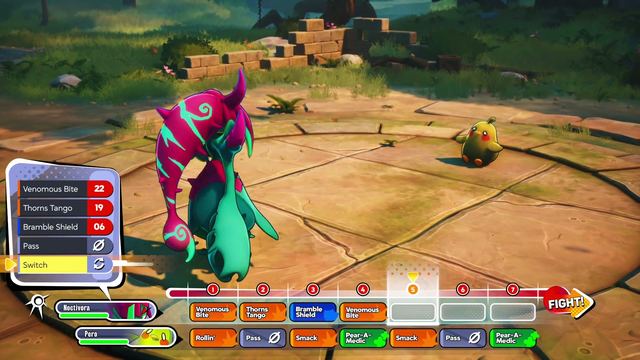
SMT matters because it solved the same design problem this game has — how to make recruiting a creature feel like a relationship rather than a dice roll — and because the studio's own writing treats Neoran as people with politics. Slay the Spire matters because the seven-turn timeline is, structurally, an intent-display system with a longer window: you see what is coming, you plan around it, and the skill is in sequencing rather than reflexes.
Where it deliberately differs from Pokémon
| Pokémon | Wonderful Neoran Valley | |
|---|---|---|
| Acquisition | Weaken and capture | Convince through dialogue |
| Creature's agency | None — it obeys | It has goals and can refuse |
| Combat information | Hidden until the turn resolves | Enemy actions visible up to seven turns ahead |
| Run structure | Linear route with fixed gyms | Roguelite biomes that reshuffle |
| Failure | Faint and heal | Lose the run, keep the knowledge |
The last two rows are what make it a roguelite rather than a collector. A Pokémon game is designed to be finished; this one is designed to be replayed.
Similar games that actually exist to play now
If you want the closest playable experience while waiting for 2028:
| Game | Why it is the right stand-in | Where it differs |
|---|---|---|
| Slay the Spire | Intent reading and queue planning | No creature collecting, no exploration |
| Shin Megami Tensei V | Negotiation, fusion, demon politics | Turn-based but no timeline queue |
| Monster Sanctuary | Monster collecting with skill trees | Metroidvania structure, not roguelite |
| Cassette Beasts | Collector with a strong identity and a twist | Open world, not run-based |
| Balatro | Item-driven build crafting | Cards, not creatures |
That list is a reading of genre and design, not a claim that any of them play identically — none of them has a seven-slot timeline.
What to expect, honestly
This game is trying to be two things at once, and the risk is real: collector games live on roster breadth and long-term attachment, roguelites live on run variance and short loops. The studio's answer — creatures you recruit once and carry, biomes that reshuffle, Jewels that define each run — is a coherent attempt to fuse them, and the roster growing from 70 to 85 between campaign and store page suggests the breadth is being taken seriously.
Whether it works is a 2028 question. What you can judge now is whether the pitch appeals: a game where the enemy's plan is printed on screen, and the skill is in what you do about it.
Next
- How the game plays — the loop in detail.
- Jewels and Sigils — the layer the Balatro comparison refers to.
- What the game is — the full identity, sources included.