How a fight actually plays out
Turn by turn: reading the Timeline, placing actions, spending charges on Synapse, resolving the queue, and why the resource you spent last fight matters.
A fight is planned before it resolves. You read the enemy's queued actions, place your own across up to seven turns, spend Neura charges on Synapse moves, then let the queue run. Enemy combos and global Jewel effects mean the plan has to survive contact.
Last checked: 28 October 2026 — trailer battle screen at 0:18–0:19, studio gameplay page.
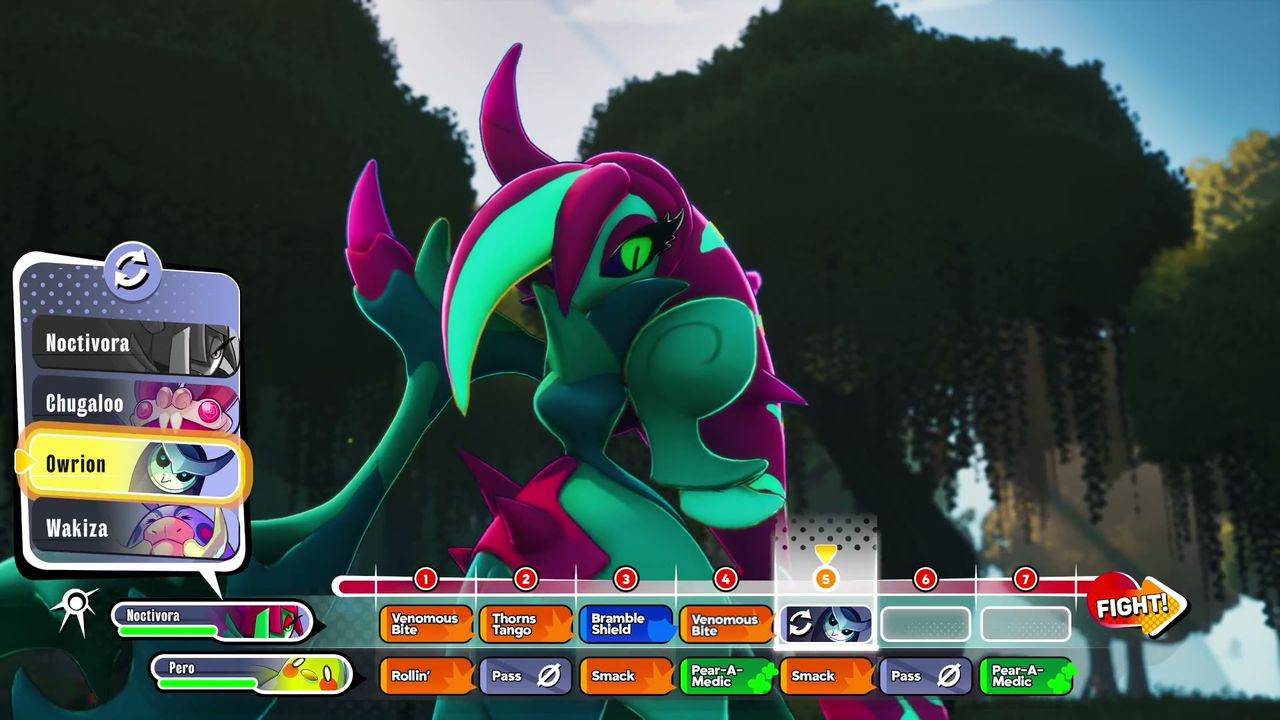
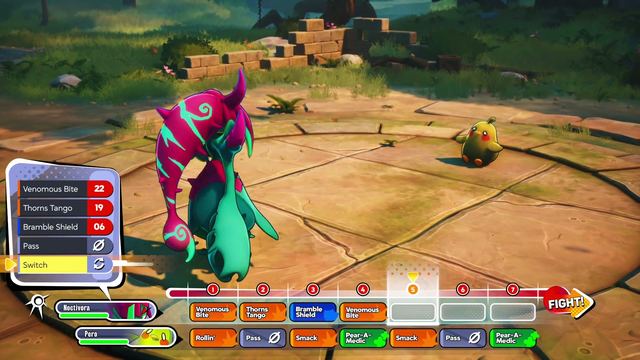
One fight, start to finish, in the order the interface presents it. This is assembled from the only public battle footage — a single held frame around eighteen seconds into the announcement trailer — plus the studio's written description of how planning works.
Step 1: the encounter opens on a shared queue
The battle screen puts everything on one line. Your party's planned actions and the enemy's planned actions share the same seven numbered slots, so the first thing you do in any fight is read, not click.
On the trailer frame, the layout is:
| Zone | Contents |
|---|---|
| Left column | Party nameplates with health: Noctivora, Pero, Chugaloo, Owrion, Wakiza |
| Centre bottom | The numbered queue, slots 1 to 7 |
| Action area | Ability list: Venomous Bite, Thorns Tango, Bramble Shield, Rollin', Smack, Pear-A-Medic |
| Universal options | Pass, Switch |
| Confirmation | FIGHT! |
Step 2: an optional Synapse before anything else
Before the queue is committed, a Synapse action can resolve in the planning phase. The studio's example is a Knight neutralising a Biskem's Cloudbreak — a +300% damage attack — with Sagira's Silent Assassin for two Neura charges.
The sequencing is what matters: a Synapse changes what the queue contains, so doing it after you have placed seven actions means replanning seven actions. Experienced players will decide the Synapse first.
Step 3: place actions, one slot at a time
Each placement is a bet about what the queue will look like when it resolves. Three kinds of bet exist, based on the labels visible in the trailer:
- Prevention — Bramble Shield. Put it on the slot before the hit you cannot eat.
- Setup — Thorns Tango. Multi-target or multi-turn actions want to land before your payoff, not with it.
- Conversion — Pear-A-Medic, Smack, Venomous Bite. Damage and healing that turn slots into progress.
Two of these are worth understanding before you play: Pass and Switch. Pass means a creature deliberately does nothing, which is how you hold a slot open or let a charge build. Switch means changing which creature is active, which is a real cost in a system where every slot is a resource.
Step 4: confirm and watch
FIGHT! commits the plan. The queue then resolves in order. The outcome is not a surprise — you already saw it — but the interaction between enemy combos and your own is where plans break, because enemy Neoran often run their own multi-turn sequences inside their portion of the timeline.
Step 5: count what is left
The studio's framing is that every resource spent today is missing tomorrow. Inside a run, that means a fight is never scored on "did I win" alone:
| Outcome | What it costs you later |
|---|---|
| Win with a creature at low health | You must protect it next fight, or lose it |
| Win by burning charges early | No Synapse when the next queue has a finisher |
| Win slowly to save resources | More fights, more chances to lose a creature |
| Win by sacrificing a recruit | The studio's own example — a Sagira traded for a Pero that then cannot handle the next room |
That last row is the design statement in miniature. The studio asks what good saving a Pero is if that Pero can do nothing against the next opponents. Winning is not the goal; winning with a team that still works is.
What is not shown
No damage numbers are legible in the published frame, no status icons, no turn counter beyond the seven slots, and no post-fight screen. Anything published today about combo timings, status durations or damage formulas is inference from the genre.
Next
- The seven-turn timeline — how to read the queue before you commit.
- Synapse — the pre-timeline action, with the charge economy.
- Progression and runs — what a fight costs you across a run.